Horizontal Thinking: Leading after the end of the specialist era
When do you let the agent press Publish?
For 250 years careers were built like ladders: vertical, one identity deep. AI took the ladder away. This keynote, built on Dorka Nagy-Józsa's book Horizontal Thinking, is about what remains: owning outcomes, seeing across domains, and the leadership decision almost everyone is currently making by accident, namely how far the agent may go before a human has read its work.
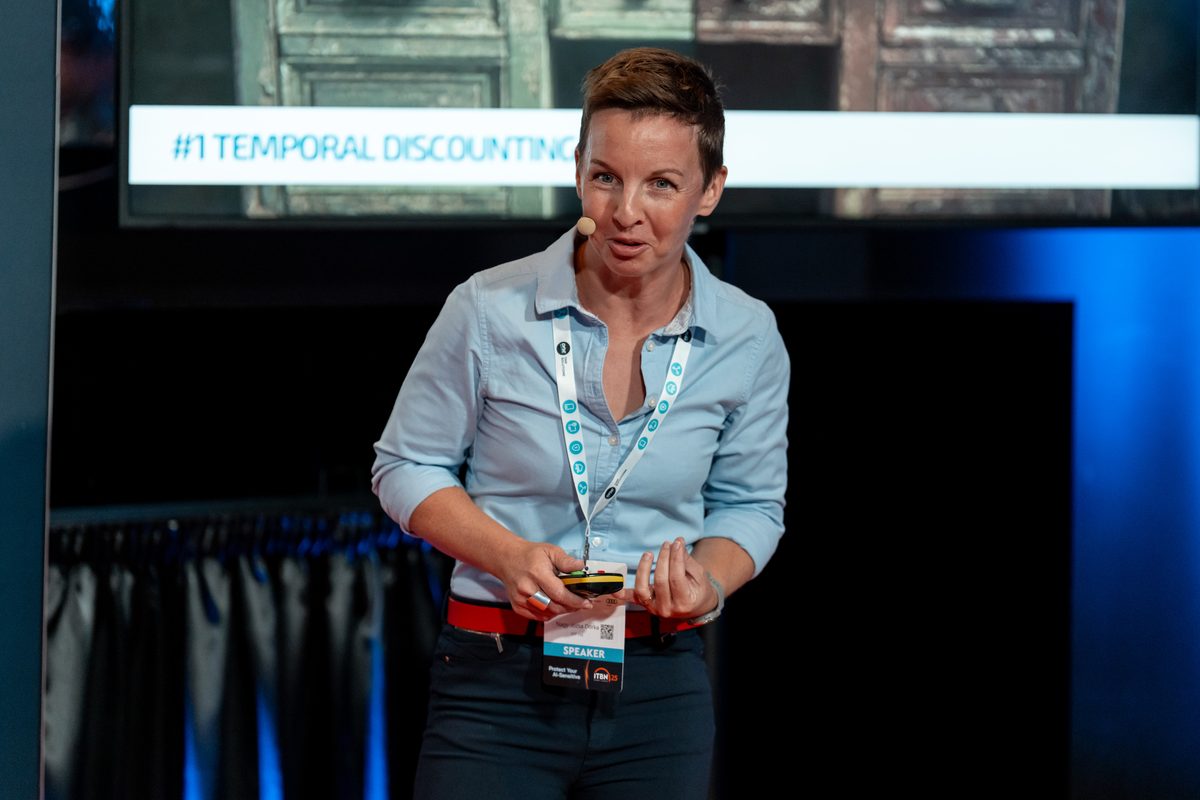
AI might not take your job. The task pile is already gone.
AI might not take your job. But if your job is a pile of tasks, nothing else, it is already gone. Dorka Nagy-Józsa starts with the oldest project humanity has run, a tool that does our work for us, and the uncomfortable news that it just shipped. The specialist era did not die of failure. It died of abundance: depth now costs twenty dollars a month.
What remains is horizontal. Owning: putting your name on an outcome, the part organisations build whole org charts to avoid. A position, not a task pile: what breaks if you leave. Seeing across domains you don't fully own, while machines supply the depth. And the recognition that leading humans and leading AI agents are two different cognitive sports: one is a relationship, the other an architecture.
Then the question at the centre of the keynote, the one the book calls the central leadership question of the next five years: when do you let the agent press Publish? Dorka takes the room through the agency ladder, five rungs from Draft to Autonomous, and shows why placing a task on it is a leadership decision that expires. You can delegate the button. The name never goes with it. The human belongs on the name, not in the loop.
Leaders who want to place their own tasks before the talk can use the agency ladder map on the book's site.
Along the way: back-sitting, the people who stay out of fear and show up as loyalty on the retention dashboard; the honesty gap, and why people are more candid with a chatbot than in most meetings; visible work; and why AI is not stealing your creativity but starving it. Each part ends the way every chapter of the book does, with something to do on Monday.
What people take home
- The agency ladder: five rungs of AI agent autonomy, and a way to place each task on purpose rather than by accident, with a date to review it
- Ownership that does not climb with the agent: whose name absorbs what happens next, at every rung
- A position, not a task pile: owned outcomes plus bridges across teams that no restructuring slide can delete
- Back-sitting: how to reread a green retention dashboard as a fear metric, and what leaders can do about it
- Two tracks: why the best people-leaders often struggle to lead agents, and how to tell which track is yours
- A keep-human list: what stays human by name and is practised on purpose, so the team can still tell when the machine is wrong
- A Monday list: ten tasks placed on the ladder, one promoted a rung, one demoted, and a 90-day review in the calendar
Leaders deciding what the agent may do
Leadership offsites and senior leadership days where AI has moved from the strategy slide into the workflow. Kickoffs for a year in which agents join the team. HR and people conferences asking what happens to careers, retention and development when the tasks move. AI, marketing and agentic-AI summits that want the leadership question rather than another demo. Industry conferences with a leadership track.
It works for mixed rooms: the C-suite, middle managers, and the quiet experts who never wanted to manage anyone and are about to run the biggest teams of their lives. The question at its centre is one Dorka already puts to agentic-AI and marketing audiences; this keynote gives it the whole stage.
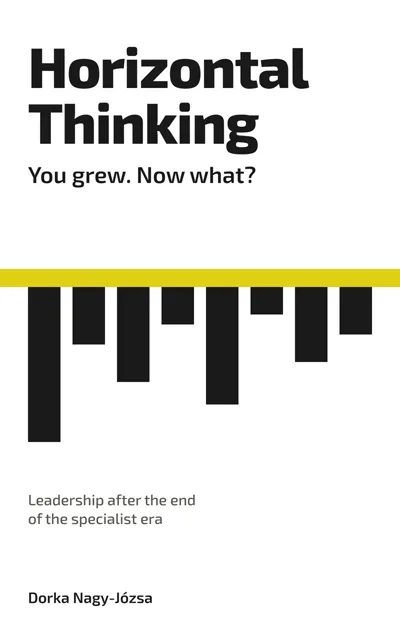
Horizontal Thinking (2027)
The keynote is built on Horizontal Thinking: Leadership after the end of the specialist era, published by Y2Y Ltd. and out January 1, 2027. Dorka wrote it together with Cody, her favourite and most senior AI agent. Every sentence went through her, and she owns all of them, which is the book's argument practised on the book itself.
"Depth used to be the career strategy; now it's a subscription. Dorka Nagy-Józsa writes from inside this disruption with rare honesty and hard-won optimism, helping leaders learn horizontal thinking as the defining leadership discipline of our time."
"Organizations were designed around the scarcity of expertise and the need to coordinate specialized work. AI is challenging both assumptions. Horizontal Thinking explores the implications for how we structure organizations and develop leaders - a valuable contribution to the conversation."
How it works
- Keynote
- 30-75 minutes, live, customised after a pre-event stakeholder call. Audience Q&A and a post-talk summary deck included. From €3,000 plus travel and accommodation.
- Languages
- English. In Hungary, also in Hungarian.
- Book
- Signed copies of Horizontal Thinking for attendees, welcome packs or VIP gifts, at a bulk author price. Ask in your enquiry.
- By event type
- Leadership offsites & senior leadership days, Kickoffs & annual meetings, HR & L&D conferences, AI & technology summits, Industry conferences (talent & leadership track), Town halls & all-hands, Procurement & supply chain congresses, Corporate events in Budapest
- Related keynotes
- AI, Your Brain & the New Rules of Work · The Neuroscience of Why Change Fails · Built to Lead: Sport Science Meets the Boardroom
Answer within 48 hours. Tell us the date, the city, the audience and the slot.
From the book
Questions organisers ask
Does the audience need to have read the book?
No. The keynote stands on its own. The book is there for the people who want to go further afterwards.
Is this a keynote about AI tools?
No. It is about the leadership decisions AI forces: what the agent may do without a human, whose name is on the outcome, and what people build when the tasks move. It is not technical, so it works for mixed rooms.
How is it different from AI, Your Brain & the New Rules of Work?
AI, Your Brain & the New Rules of Work is about the human brain at work and how leaders win buy-in for AI. Horizontal Thinking is about leadership after the tasks have moved: ownership, position and leading agents. The ideas of the book run through all of Dorka's keynotes; this one is the book itself, on stage.
Can the keynote be adapted to our event?
Yes. Like every keynote, it is built after a pre-event stakeholder call around your theme, your audience and the decisions your leaders are facing.